Carlota's Trunk
La piel del tamborCarlota's Trunk is the family repository of Carlota Bruner's belongings and unsent letters to Manuel Xaloc. More than a container of heirlooms, it preserves a life that was hidden and interrupted: its objects let Macarena Bruner encounter her great-aunt as a person, while the letters expose how her family prevented the lovers from communicating.
Discovery and Provenance
Macarena identifies the old postcard of Nuestra Señora de las Lágrimas as hers, taken from Carlota's trunk, and is startled that Lorenzo Quart has it. She explains that her great-aunt Carlota was in love with the impoverished sailor Manuel Xaloc. After Xaloc emigrated to America, Carlota wrote to him almost every week for years. Her father, Duke Luis Bruner, bribed the city's postal officials to stop the correspondence; for six years, Carlota received no letters, and the family believes Xaloc received none from her either.
The trunk survived Carlota's death in 1910. Her letters were not destroyed, but stored with her possessions, where they remained a private family archive. The postcard Quart discovers is one trace of that interrupted correspondence: it was never mailed, and its message, that Carlota prayed for Xaloc every day, never reached him.
Contents and the Life They Preserve
As a child, Macarena was fascinated by the trunk and tried on Carlota's dresses and jet necklaces. At ten or twelve, she read the letters one by one, and the romantic figure of her great-aunt captured her imagination. Her memory of the trunk is therefore not only a catalogue of inheritance; it describes the beginning of a lasting attachment to Carlota's story.
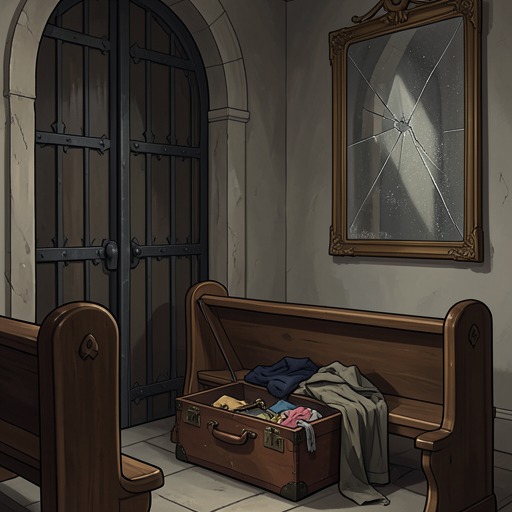
When Quart later examines the trunk, its contents range across the textures of a whole life: lacquered boxes, jet beads, a porcelain figurine, broken fans, a worn lace mantilla, hatpins, corset stays, photographs and postcards, poetry books and school notebooks. There are also travel keepsakes: a catalogue from the Paris Universal Exposition, a guide to the ruins of Carthage, ancient coins, a miniature gondola, and a glass paperweight containing a seahorse. The accumulated objects place travel, education, fashion, and private memory side by side, preserving the varied life that Macarena had imagined from childhood.
The correspondence forms the trunk's most consequential contents. Quart counts about fifty pieces, nearly two-thirds folded letters and the remainder postcards, tied into a thick packet. Their paper has yellowed and become brittle; the ink has faded from black or blue to diluted sepia, sometimes nearly illegible. None bears a postmark. All are in Carlota's fine, slanted English hand and addressed to Captain Manuel Xaloc at the port of Havana, Cuba.
Intercepted Letters and Missing Voices
The trunk preserves the evidence of a deliberate silence. Macarena says her great-grandfather burned Xaloc's letters as they arrived at the post office, while Carlota's outgoing letters were withheld through the bribed postal officials. The archive is consequently one-sided: Carlota's words remain, but Xaloc's replies do not. When Quart asks whether any of his letters survived, Macarena answers that there are none. The surviving packet can show what Carlota wrote, but not what he told her.
That imbalance sharpens the tragedy preserved by the trunk. When Xaloc returned from America to find Carlota, she had lost her reason, spent her days watching the river from a window, and could not recognize him. The letters and keepsakes give the lost relationship a material presence, but cannot restore its missing exchange or undo the years in which communication was suppressed.
Memory, Inheritance, and the Present
The trunk connects a private family archive to the wider struggle over memory in the novel. Macarena understands her defense of Nuestra Señora de las Lágrimas and her preservation of Carlota's memory as part of a personal battle against time and forgetting. She describes herself as belonging to an extinguishing social order, yet refuses to let its beloved places and stories disappear without resistance. The trunk gives that resolve a concrete form: a vulnerable collection of paper, fabric, and keepsakes carried forward across generations.
Its contents also make memory intimate rather than abstract. Macarena's childhood acts of trying on Carlota's clothes and reading her letters turn inherited objects into a means of imagining another life; as an adult, she recognizes the postcard and understands that someone removed it from the trunk in her home. The object has left its archive and entered Quart's investigation, linking the family secret to the present while underscoring how easily a fragile record can be displaced. The trunk cannot supply the missing letters from Xaloc, but it keeps Carlota's voice, and the fact of its suppression, from vanishing altogether.